Friday, 25 August 2017

Tonga - The Friendly Islands (with a lot of rain)

Hanateli and his botanic garden
Into each life (and ocean passage) a little rain must fall - we had a fair bit of rain back in May in the Marquesas, which came in short intense bursts, but not much since... until we reached Tonga. Our crossing from Niue (just the two of us, as Peter and Sue had left us there) was rough, rolly and windy and wet. We were trying to go slowly so as to arrive in daylight, so had a heavily reefed main and a tiny staysail, but were still rushing along at 8.5-9 knots. Neiafu Bay, in the Vava'u Group of the Kingdom of Tonga, is amazingly sheltered, yet even in there, boats were dragging their anchors and pulling the mooring buoys. After checking in (what a lot of form-filling, which some of you will know I secretly enjoy!), we went ashore to find internet and re-connect with lots of Oyster friends
we hadn't seen since Bora Bora. Many of them had sailed straight from there, missing out on all our wonderful Maupiti/ Mapihaa/ Aitutaki/ Palmerston/ Niue experiences - such a shame, we feel.

We have enjoyed a great tour of the Botanical Gardens at Ene'io, shown around by Haniteli, former Agriculture Minister for Tonga, who started collecting plants when he inherited the land aged 8. The name Ene'io, which means to tickle someone until they say yes, is very appropriate for someone who has managed to extract celebrity and sponsorship funding for his
venture. Hanateli is a charmer who regaled us with stories of Tonga, his life and his garden. He introduced us to his wife Lucy, who works in town at the Ministry for ... well, everything: culture, the environment,  medicine, education. She in turn took us to the hospital eye clinic, and that contact, Mary (Mele in Tongan) has shaped our time in Vava'u so far. The hospital then got in touch itself and through its two clinics in the rural areas, and so to the Town Offices and then to the people by loudhailer to say "come to eye clinic Monday 0830".  So we have run three eye clinics, one in the remote western end of the island where there were about 60 people waiting for our arrival, and have seen about 120 in all.
Thank you present Tonga
We have increased our efficiency dramatically, but it still is particularly rewarding to help people with short sight move 4 or 5 lines down an eye-test chart or see the other side of the road for the first time thanks to our clever eyejuster glasses that can be altered to serve a range of short sight. Charles has tried them, and while he can't read the top line without glasses, he can read to the bottom line with the eyejusters, so they are really a very clever $30 invention. Reading glasses for the older population help them
with their bible reading and sewing. Another Oyster, Meteorite, went east and distributed glasses to over 90 people. That means that we have distributed glasses to 2% of the population of Vava'u of about 12,000. There's a huge need but not all cases are simple. For the more complicated cases (cataracts or diabetic retinopathy) patients have to wait until a surgical team arrives in November. No glasses at all are made in Tonga. All most outsiders know about Tongans is that they are large. That's true, and it means that diabetes is a huge problem and impacts on Tongans' eyesight and health. The islanders are very friendly; one worries that they are suffering from a diminishing gene pool as many younger and smarter emigrate. Agriculture seems vibrant, tourism albeit undeveloped; aid (from
Australia, Japan and China) and remittances are evident.

Rain, rain, rain. One morning the dinghy was full of rainwater to above the paddles - nearly 20cm! Not wanting to trudge too far through the puddles, I ended up at the nearest school to the town centre, a leaky-roofed
Tonga school singing
English-language primary school with 40 children and 4 teachers. The Head, Dorothy, welcomed me in and I read a book about London, introduced Lucky the Pakeman Teddy in his orange lifejacket and listened to enthusiastic singing. Charles and I returned to give them an inflatable globe, on which we were
able to show them what a long way from London we have travelled.

Oyster definitely know how to throw a party. Most of the yachts navigated their way last Friday through shallows and coral reefs to the uninhabited island of Kenutu, on the eastern edge of the Vava'u Group. There, we were treated to a Tongan feast, fire-juggling and Tongan dancing. We stayed on for another day and had a barbecue on the beach.

Oyster beach party
The water here is a beautiful greeny-blue and we found some beautiful snorkelling near Mala, nicknamed the Japanese coral garden. There are also lots of caves, but they need better visibility. We are booked to go swimming with whales again, having found it such an extraordinary experience on Niue.

For now, we are settling in to watch a DVD and hoping for better weather. We've enjoyed The Missing and have lots of ideas of books to read, after a fun session of the OWR Book Club, where we all contributed suggestions. Our next book is Golden Hill, about late 18th century Manhattan.

In a few days we will head to Fiji, about 350NM away, where we'll spend about five weeks. There's lots to see so we have been planning a route and on-shore activities.

Friday, 11 August 2017

Niue - the smallest country in the world

Niue has only 1500 inhabitants but it has a primary school with 250 children in it.

It is the largest lump of coral and lava in the world, and is cliff-faced with an outlying reef around it, but no passes around it. So getting ashore means bringing the dinghy into the wharf and lifting it out on a little crane.  Once you have the knack of it, it works fine, but it means you think twice about popping ashore for a beer or some shopping.


We waved goodbye to Peter and Sue in Niue after a month on board; we have been together to some very extraordinary places in very remote locations and it has been a very happy time, with some good sailing- about 1200 NM in all.  A happy and competent crew.

Niue is a lovely island; we have been diving, whale-watching and snorkelling with humpback whales. The whales have been swimming in the anchorage where we are moored. We have hired a car and driven round the island where there are many sea tracks marked, which are paths down to the coast or onto the reef where you can go exploring. There is a golf course of sorts, bikes for hire and general chill out. Nicky visited the happy and thriving school.  We have become members of Niue Yacht Club which has 1669 members now and bought the burgee and the T-shirt!
Charles on south coast of Niue


Locals have been very friendly; quite how the economy works is as ever a question with these Pacific islands. NZ support is evident and the currency is the NZ dollar. The supply ship has been in for the last 4 days, off-loading and on-loading containers one-by-one, which requires crane from ship to barge; crane from barge to lowloader, then crane off again. Quite a process.

Niue chasm
Today we leave for the Haapai group in Tonga. There is a weather system with 35 knot winds forecast so we want to reach shelter before that arrives next Tuesday - which by then will be Wednesday as we are about to cross the international date line, and lose 24hours!


Peter and Sue on Aitutaki
Humpback whale in Niue

Saturday, 5 August 2017

Guest Blog - Peter and Sue

Guest blog by Sue and Peter Wood

27 August AITUTAKI (Charlie's Island)

Salon Calliope
Arriving late morning, we anchored on a deep narrow coral shelf, fringing the reef, outside the one "Arutunga Pass" on the west of the island. A huge shallow blue lagoon stretches south/southeast surrounded by eight or so motu
(tiny islands). This one pass, blasted by the US military in WW2, well-marked through the coral, allowed a draught of 5.5 ft - not for Calliope! Despite our flying the Q flag, officials seemed uninterested in our arrival so, anxious to secure scooters for the weekend, we went ashore regardless.

With Charles and Nicky "two-up" and Peter and I solo, mistrusting each
other's scooter skills, we enjoyed "sundowners" at the 5 star, beautifully manicured, Pacific Resort, at the NW tip of Aitutaki. Well equipped for exploration on Sunday, we could not help but be drawn to the Cook Islands Christian Community Church, belting out their Sunday morning
Cook Islands Christian Community
Halleluiahs, raising the rafters, causing "goose-bumps" and even a
tear of overwhelming emotion - a sound we will never forget.

With 50cc engines protesting, we climbed 400 feet to Peraki Lookout for a stunning 360 view of this gem and its motus. A circumnavigation revealed cultivation of bread fruit, pineapple and coco, a "golf course" next to the airstrip, many abandoned shacks, several rugby posts, a community of kite
suffers and, as we have seen on many of these Polynesian Islands, family burial sites in the back yard.

We were excited to find Charlie Wood's house ! "Mister Charlie" (Peter's son), spent six months living on Aitutaki as an 18 year old, teaching in a primary school and drove the local troupe of traditional dancers and fire eaters around in a minibus in the evenings. It is so much easier now to
imagine his life here and enjoy all the places as described by him 7 years ago. We had brought a photo of Charlie and five of his pupils and found a young boy who knew two of them.

More traditional singing awaited us that evening; not put on for the benefit
Aitutaki church singing competition
of tourists, of which there are few, but an island just getting together.  We dined at the Pacific Resort, celebrating Charles and Nicky's 34th wedding anniversary with delicious food and fine wines. Congratulations!

On Monday morning the wind shifted suddenly so it was time to go. We watched a small Swiss yacht fail to lift anchor, snagged on the coral, with much damage to windlass and bowsprit. With a masked signaller in the water (Charles) and Peter on helm, we eventually un-snagged our wrapped chain and were free - next stop, Palmerston 198 miles away to the West.

30th August PALMERSTON ATOLL

Measuring 6 miles by 4 miles, this atoll surrounded by lagoon and about 24 small motus (one of which is called Kiss Me Arse, was first inhabited by William Marsters, a Lancashire sea captain who settled here in 1862 with his three wives he had acquired in Penrhyn, one of the other Cook Islands. Over the years he fathered 26 children and divided the island into three segments, one for each family, with strict rules on marriage and inheritance rights. He was, and still is, referred to as "Father" and English was the decreed language. His original home, built from shipwrecked timbers
(destined for Australian goldmines), still stands. Coconut palms cover all the islands and a handful of mahogany trees in the centre stand majestically. Their timber is used for construction. Just 50 people live on
Bill Masters' grave and eight generation Henry and Matilda
the Island now and, thanks to a gift from Queen Victoria to the original William Marsters, they own the island outright. They claim to have recently turned down an offer of $30 million from a rich Brit.

On arrival, each yacht is greeted by one of the three families who act as water taxi, tour guide and host, in our case seventh generation Bob Marsters. They are very proud of their history and keen to share old stories about their forebears.
Parrot fish fillets are exported by refrigerated
ships, three or four times a year, earning as much as 27 NZD per kilo when sold to restaurants and hotels in Raratonga. Bob claimed that they export 10 tons of fillets per year which at 27 NZD equates to about £180,000 or £9000 per person on the island.

Bill Marsters' house built from shipwreck timbers
Martha, a qualified nurse from Fiji, is the only medical personnel on the island, dealing with newborn deliveries, dental extraction, diabetes, heart disease, defibrillation - you name it, she does it! We asked her how long she would have to wait for help in a serious emergency; nineteen hours, she replied without any hint of worry !! Supplies were plentiful, the drug
cupboard well stocked and a new delivery of 4 wheelchairs sat on her veranda. Martha also doubles as the Health Official and came aboard to spray our boat with insecticide from bow to stern.

The school, modern but roofed with plaited banana leaves, is well laid out and seems to have everything it needs including two young South African teachers. The 14 pupils, aged 5 to 19, follow a home-schooling programme, so they mostly work independently. We enjoyed spending time with Bob's youngest children, Henry 4 and Madinia 7.

Despite their laid back, almost comatose, attitude to life the Masters families seem exceptionally adept at getting money and gifts showered on them. Witness the brand new solar power station, brand new medical facility, street lights, broadband/telephone, brand new water storage and in particular two full-scale JCB-style diggers donated by China.

Regular hurricanes pass through Palmerston, most houses having large concrete blocks buried underground with shackles attached. The corrugated tin/timber houses are then lashed down by rope to these blocks, in an effort to keep it from being totally flattened by the 80-300 kn winds. Our
contribution, an old halyard, was gratefully received.

Bob Marsters and traditional boat
Despite Palmerston's completely isolated position, wifi is available to all, street lamps line the coco avenues, many examples of western packaged food are evident and the lunch served to us on both days included no local ingredients other than parrot fish fillets. This was particularly remarkable and in stark contrast to Mopelia where we saw the hardworking, totally self-sufficient people of Polynesia.

The snorkelling was amazing ! Fifty meters from Calliope we swam to the reef finding parrot fish 60-70 cms long, the iridescent blues and greens unreal, huge Napoleon fish, three different types of shark, immense Grouper (150cms) emerging like dinosaurs from the pass. At one point, alone in the water, only 20 m from the boat, Sue was surrounded by 5 or 6 six sharks and an enormous menacing "Barry Barracuda" - she admitted to being genuinely frightened for the first time this trip and shot up the swimming ladder in 1.2 seconds!!

We left feeling that this stunning gem of an atoll felt "strange". Incest is prevalent, marriage only banned to siblings, a lack of aim, and dare I
say, an eerie unhealthy and quite odd feel to it.

Much reading has been done on board - Peter is on his 10th book, which is more than he usually reads in a year. Sue and Nicky have been sewing,
creating a top out of a sarong and a dress out of material Bron brought back from Africa. A sewing machine would have been helpful, but we had time, so didn't mind backstitching. The finished creations were much admired by other yachties.

Food supplies on Calliope are holding up well (gin and wine less so, though we don't drink on passage). The fish we were given as a thank you for glasses in Maupiti has been made into fishcakes for lunch today. It will be good to find more greens (salad especially) in Niue, now less than 100NM
away; the market in Aitutaki was disappointing, though it did yield some tomatoes and carrots.
A new meaning to small government

Some great sailing and far less motoring than we feared would be necessary
-" altogether a right old romp" ( quote Peter) !

Sunday, 30 July 2017

Out into the deep blue - Maupihaa and meeting Tuarae - eye clinic in Maupiti

Dinner Mopelia
I finally feel as though we can match Alex a bit for having met the locals and not just being a tourist trip passing through beautiful places.

We spent three nights on Maupihaa (the Polynesian name) or Mopelia in the francophone version. We dined one night with Tuarae, his Italian girl Friday Gianne, Opupu and others.


Dinner was langoustes, crabe de coco, red snapper, parrot fish, benitiers (the inside of clams), breadfruit and tapioca, poisson cru au lait de coco. Not a great meal for Nicky, but the
Opupu and Coconut Crab
rest of us found it delicious. We had gone ashore the night before and none of the above had been organised. Langoustes are caught at night on the windward side of the reef by torch light as they come in to shallow water to feed - so caught by hands which are best protected by gloves! Crabes de Coco are huge and are caught in the forest; fish is caught by spear gun in this case outside the passe in the ocean. This was the hippy night - music
and singing, smoking of the local Pakololo, drinking of home-made hooch. All food served off leaves and eaten with fingers. The hermit crabs tidy up any scraps or leftovers.

Then the following night we dined in style with Adrienne and her two daughters; a matriarchal society who very much are not hippies but are
making their part of paradise produce the maximum amount of food and copra - the cash crop made from dried coconut flesh. Adrienne and family (her
husband Marcelo heads the cooperative) are the most productive copra producers on the island and they manage to harvest about 3 tonnes every 3 months. You need 40 tonnes produced by the island cooperative to justify the supply ship coming to pick it up, so it only comes twice a year.

Adrienne and daughters have some English, good in the case of one of the
daughters, learnt from books and films and some at school. They were all on the island 22 years ago when the last cyclone flattened it. Adrienne then had a 5 year old, a 2 year old, and a baby. Husband was away and the water came into their house about waist high. Luckily all survived; they then had some time away from the island and came back 5 years ago, and with much hard
work have created a very well organised home. Food comes easily in paradise, but everything else, including staples such as rice and flour must come on the supply ship.

The supply ship also only takes 2 passengers by law, which is where sailing boats come in and why Calliope and its crew had such a wonderful welcome. We were anchored in Maupiti lagoon when Hio - the son of Adrienne and Marcelo - came across in his boat with Tuarae. Hio speaks excellent English and skippers yachts. He also builds radios from scratch, is starting pearl farming in Mopelia and is super bright and energetic. So Hio was there to ask if we would take Tuarae and "some" packages to Mopelia, which is 100NM downwind of Maupiti.
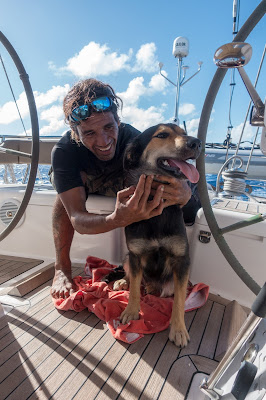
Tuarae and Dalia
We say yes - word gets around, so we then have two more passengers who ask, but who in the end don't make it although their parcels do. We then go for a walk to the top of Maupiti which is a steep climb up 300 metres with stunning views of the lagoon. Tuarae comes to guide us- helpful, though not
needed - but a good chat, and then leaves us to go collect his cargo. As he
is leaving, he asks "do you mind if I bring Gianne's dog with me". So we
say no problem. Dalia, a young German Shepherd, was impeccably behaved, sleeping in Tuarae's arms in the cockpit, her bladder holding out until we were an hour from our destination - though she left us a lot of dog hair as a souvenir!

When we reach Mopelia, which is an atoll with no mountain in the middle like the Tuamotus, unlike most of the Society islands like Tahiti where the
mountain is still there inside the reef, we are met by two of the local
craft and unload dog, bicycle, a dinghy full of bananas, assorted barrels, many bags of rice, sugar, and other packages which have filled both forward bunks and two jerricans of fuel, plus Tuarae.
Calliope discharging to lighters
So what for us had been a very simple helping hand over a 16 hour voyage was an important supply service for the island and rewarded way over the top by the hospitality we received. I should add that the total population of the island is 18! Most have relatives in Maupiti and spend time there as children. You are allowed to buy 200 metres of shoreline and the land going through the Motu from lagoon to ocean, maybe 3/400m deep, for $40 and that land is yours to harvest from the coconuts which are there. A ton of copra is worth about
$300, so that is the cash economy.

For eggs you go to bird island, where there are multitudes of frigate birds and a tern like bird which lays eggs on the sand in abundance. Pick up the eggs, take them to the shallows; if the eggs lie on the bottom horizontally, they have no embryo in and you can eat them. If they float or stand
vertically, put them back on the sand to hatch.

There are thousands of eggs. Tuarae told us his simple test to find out whether a fish has the potentially fatal toxin ciguatera: leave it out, wait till flies land on it and if they die, don't eat the fish. One of Adrienne's daughters said flies won't even come near poisonous fish. Either way, trust those flies... though we were also told there's no ciguatera or stone fish here.

So Tuarae and friends have fed us, provisioned us, and Tuarae on our last night went langouste hunting again giving us six cooked langoustes to take with us. In return, we have left them with our old but in very good  condition mainsail halyard, olive oil, various perfumes, spaghetti and tinned tomatoes in case Gianne feels homesick, some LED lights wired and ready to plug into their solar-powered battery (though one of the batteries is dead and we are not quite sure how Tuarae will source another car battery), reading glasses for Gianne. They think they are in our debt; we think quite the contrary. Adrienne has the old genoa sheet, a box of reading glasses for the island, olive oil and perfumes etc for her girls.

We would have stayed longer but we suddenly realised we had Peter and Sue's return flight dates wrong by a week so we have to push on towards Tonga. We have just reached Aitutaki which is where Charlie Wood spent his gap year. The passe into the lagoon is too shallow for us so we have anchored outside the reef. We will go on to Palmerston and Niue, both of which have mooring
buoys on the lee side and no lagoon.
Maupiti lagoon and pass


Talking of reading glasses, we held our first eye clinic in Maupiti. Nicky was in charge and what a fabulous job she did of arranging and organising it. Over to her.

On a long voyage like this, we seldom stay anywhere very long, and we're usually ready to move on to the next exciting destination, but I must admit to feeling quite sad to leave Mopelia this morning: the people we have met,
spent time with and been able to help here and in Maupiti have been so welcoming and
Calliope in Maupiti lagoon
opened their lives to us. They're not particularly curious about where we come from, just eager to share their bit of paradise.

So, the eye clinic. We've had 500 pairs of reading glasses, in assorted strengths, on board since Antigua, and four dozen 'Eyejusters', very clever adjustable glasses for short sight, caught up with us in Moorea. We'd managed to use a few readers to barter with when we first arrived in Fatu Hiva and had no Polynesian currency, back in early May, but had begun to wonder whether we'd ever manage to find a market for all the others.
Eye clinic Maupiti
When we arrived in Maupiti we spoke to the mayor, who arranged a room we could use and sent out word that we would be running a clinic the following day. We had a queue outside already when we arrived at 3pm and Solange (troisieme maire adjointe) was fantastic at keeping them orderly, sending people in one
at a time to "read" the symbols (capital E facing up/down/left/right) on our chart. If they managed that, I passed them on to my incredibly efficient and capable assistants, Charles, Peter and Sue, who repeated the test at
close quarters to establish whether reading glasses were needed. It was very gratifying to watch individuals go from squinting and faltering over line 2 on the chart, to romping through to the very bottom line. One man, standing on the balcony outside, exclaimed 'there's a yacht out there!', not having been able to see it before. Although an opthamologist does visit the island every few months, those we were testing can't afford their services. They were surprised not to have to pay any money for their glasses.
Within half an hour, thank you presents began to arrive: shell necklaces, crowns of flowers, grapefruit, cucumbers, a cabbage, bananas, lemons, a little bag of pearls each for me and Sue, and fish: a huge piece of tuna fillet and a
yellow and black striped fish, both frozen. We shut up shop at 6pm and ran another small clinic the following morning before climbing the mountain.

Earlier that day, we'd hired bikes and ridden around Maupiti, which was impossibly pretty, with sandy beaches (you can wade across the lagoon in places), tall, leaning coconut palms and beautifully kept gardens, many with family graves in them (what happens, we wondered, when you move house?!) Even the dogs were friendly: one of them accompanied us on our ride. No shops at all, but a post office at the hub of the village with a wonderful congratulatory poster stuck up outside: in December last year, 30 Maupitians passed the first ever driving test administered here and there they were in a photo, solemnly lined up with their certificates which entitle them to drive the 10 miles round Maupiti's one and only road, but which are not valid on other islands.
Maupiti's first driving test!


We hear some news of other Oysters, mostly behind us for once after we have been tail-end Calliope from the Caribbean through to Tahiti. It was fun to spend yesterday (great snorkelling!) with Paulina and Mariusz of SunSuSea, who joined us in Mopelia lagoon.
Au revoir, French Polynesia - we will be back!

Navigating through passes - in the Tuamotus the passes we went through were generally wide, some shallow (Fakarava South), but, if you timed it near slack water, not too troublesome in navigating. Maupiti's passe is open to the south, quite narrow, very well marked, but, with any southerly in the wind, it can create quite some wind-on-tide as the water is always coming out from the lagoon, as the lagoon fills with water over the reef from the windward side, which has no way to get out except through the passe. Going in to Maupiti the winds had been 20 knots or so all day but from the East so we were worried, swallowed hard, looked at the smallish gap, judged the
waves small enough, and went in easily with 3 knots against, following the clear leading lines, accurate charts with just a little water over the bow. On exit, maybe over-confident and in the afternoon with stronger outgoing current, Peter and Nicky had gone forward to the bow, with cameras in hand. All appeared smooth until we met standing waves which were quite steep and
about 3 metres tall, although only about 150 metres in duration. Peter's iphone is now dead, Nicky's video has some interesting swooping movements in it, but all were safe!


Mopelia passe used to have red and green markers; it now has one white for port and one white for starboard side, is maybe 30 metres wide although very well defined coral to either side and deep right up to the marker. The Navionics charts gave good representation but we were about 20m left of where the chart plotter said.  Since it faces north-west much less risk of wind-on-tide against the easterlies, and we had softer winds around 10 knots, so we had no problem in or out. In stronger winds and waves I imagine it could become more emotional because it is so narrow and you would have much stronger outgoing current. All the water coming over the reef into the lagoon has to exit through the passe. Navigating coral heads inside the lagoon is done by sight as it is uncharted. Another one not for the faint-hearted and we had a local on board to help on the way in.
Manta Ray Maupiti

Nicky was absolutely brilliant with the eye clinic. She was the one to talk to the Mairie; she looked beautiful of course, particularly with the flower crown they made for her and Sue, gave the clearest instructions, and charmed the occasionally shy locals to do the eye tests, and organised the shy(ish)
Peter and Charles into doing the close-up tests. Being able to speak French here has been so useful, after feeling helpless in Spanish-speaking Colombia, Panama and Galapagos before Alex arrived.

Friday, 21 July 2017

Leaving French Polynesia

We are anchored in shallow turquoise water in Maupiti, which is about 30NM to the west of Bora Bora. It is delightful. An atoll with a big lagoon and with a 350m mountain in the middle. Yesterday we cycled round the island and today we have been snorkelling with manta rays in the lagoon. Not the best view so we shall try again tomorrow morning. They go out to the pass to sea to clean themselves in the morning with the aid of fish who eat barnacles etc off them, and then they disperse through the lagoon during the day.

Nicky and Maupiti church
This afternoon we are conducting an eye clinic on land. We have 500 pairs of long-distance and 40 pairs of clever adjustable short-sighted glasses with us and various eye charts, supplied by Oregon-based Sea Mercy and we will see who needs them; the mayor, whom we met this morning, has invited people to attend. Maupiti has about 1000 inhabitants and nowhere near the amount of tourism of the other islands. Bora Bora is overbuilt and overpriced, so don't go there for your honeymoon; we can suggest many better locations! Maupiti is not poor but it is less affluent than the other Society islands. 

Each island has a different feel, even Raiatea and Taha'a, which share a lagoon. On Raiatea, while Sue was completing her PADI certification, we hiked with Tiggy and James from Miss Tiggy, from sea level to the high plateau at 720 metres, saw a Tiare Apetahi flower up close - it's the national, very endangered flower - and back down again, a tiring 7 hour walk. We've loved drifting with the current through coral gardens, sometimes having to suck in the tummy so as not to graze the coral,
surrounded by multi-coloured fish.

Fish traps Huahine
Not so keen on sea slugs, though, which look like turds... We've visited pearl farms and seen the extraordinarily fiddly process of implanting a piece of shell and a small centre into pearls, and the glorious range of colours the resulting pearls display. And on Taha'a, we loved being shown round a distillery and vanilla plantation, and continue to enjoy the passionfruit rum. Thanks to Lenny and Sharon on Shalen for pointing us in that direction! Renting a car on some islands,such as Huahine, has allowed us to explore the interior and parts of the coast we couldn't otherwise get to. A friendly Ia Orana (hello) and Nana (bye) is as far as our Polynesian has progressed, but it's been fun being able to communicate in French, which we couldn't do in Spanish in Colombia, Panama and Galapagos.

We will probably leave Maupiti tomorrow for Maupihaa. It is an island with 18 inhabitants and we will be taking 3 of them with us! The supply ship only calls twice a year, when there is enough copra harvested and ready to export. The islanders take the supply ship or manage sometimes to get a
lift back 100NM upwind to Maupiti, but then they need to hitch a ride back home. The pilot book has all kinds of ferocious warnings about the pass being among the most difficult in French Polynesia; it is only 20m across but there is plenty of depth and the weather forecast looks good, and we will have 3 locals on board! The pass into Maupiti was exciting and in different winds from the south could be truly awful, but it was well marked, plenty of agitated waves but nothing too bad - power on and we made it through. The current was against us: there's always a current running OUT of the atoll, which seems strange until you think that there are always waves breaking against the reef and flooding in.

Grey shark Raiatea
So we have now been in French Polynesia since the beginning of May: Marquesas, then Tuamotus, then Tahiti and the Society islands. The last month has been in the more populated parts, but we needed 10 days in Tahiti to change the gearbox (which meant flying 130kg of gearbox and drive
mechanics from the UK, and the engineer from New Zealand), to finalise fixing the gooseneck, and to reprovision the freezer and other supplies. All done at 3x the price of Panama.
We had a lovely two weeks with Michael and his friends George and Tom. Now we are with Peter and Sue who will accompany us across the deserted Southern Pacific to Tonga via Maupihaa, Aitutaki, Palmerston and Niue. The latter three do not have a lagoon, so we will have to anchor on the lee side and hope the weather is good or leave and move on. We will be in Tonga (360 islands) mid August, Fiji (333 islands) early September and leave Fiji for New Zealand mid-October.

We have loved the people of French Polynesia, which seems remarkably prosperous, friendly, with a high sense of community and also selectively understanding that too much tourism is not a good thing; eg Huahine voted
Huahine Heiva
against any large hotels. How the economy works I really don't know. Breadfruit, grapefruit and many other fruits grow easily in your back garden, fish is still in the lagoon or the sea. Life is simple, egalitarian, and with many community activities.


It has been the season of Heiva or festivals, and we will post a video of the fabulous dancing and singing from Huahine. All the island was there and the cast was over a hundred of all ages, and all massively enthusiastic. Quite how all this enables the books to balance I don't know, but it is very happy. I suspect voting for independence would be a mistake, though we have seen a fair number of blue and white flags showing support for that idea.

We are now out of 3G coverage, so yachtcalliope@mailasail.com please.

Tuesday, 20 June 2017

The Dangerous Islands - Tuamotus and reaching Tahiti

When Charles and I first looked at the long string of atolls which make up the Tuamotus, part of French Polynesia, we had grand plans: we'd go to the smallest, least accessible, most remote ones -- lots of them.  When it came to the reality, we changed tactic and divided the time we had available between fewer atolls, trying to get to know them better.  This is definitely a cruising area to come back to and explore further.  Some of our Oyster World Rally friends are talking of basing themselves in Tahiti and sailing these waters for years.

Calliope in Makemo
So what makes them so special?  First of all, they are hardly there.  Each atoll is like a skinny doughnut, with far more water inside its "hole" than land around it. There's a hyped-up, mostly straightforward but potentially dangerous 'pass' (the entrance/exit), best negotiated at slack water, meaning high or low tide.  The scary bit is that on either side of the pass, the waves break dramatically on the reef, so as you approach, there are huge plumes of spray and crashing breakers.  Once you're in, the water is flat -- but deceptive.  It's a beautiful deep cobalt colour when deep enough, and even more beautiful vibrant turquoise where "boomies", columns of lava, rise from the bottom to catch yachts unawares.  In years of sailing, I'd never been up the mast in the bosun's chair (a fabric seat hauled up by ropes), but I thought I should face my fears - that's partly what this year is about, proving that even in one's 60th year, one can take on new challenges - so with scarcely a tremble, I allowed myself to be hoisted to the first spreaders on the mast... and guess what? I loved it up there.  From a height, it's easier to spot changes in water colour.  I think the charts alerted Charles to dangers anyway, but my excitable squeaks just may have contributed to our safe transit of the atolls.
Plastic Makemo


Tuamotu people are special, too.  Marquesans were tough and friendly.  These atoll dwellers were softer: they grew flowers and painted their garden walls lilac and fuchsia.  There is no soil on the atolls, so growing anything is hard.  Vegetables and fruit are all imported, as is all food except fish and coconuts, so I'm in awe of the cooks in the restaurants we went to, making the most of tinned ingredients and deliveries which arrive every week or fortnight.

Our outboard engine, which has been giving us trouble for a while (Galapagos fuel? maybe), decided to play up badly while we were in Fakarava.  Roger and Dinah ended up staying an extra night as we couldn't deliver them to their "Crusoe chic", electricity-free resort.  That was fine - we found another frozen meal in the depths of the seriously depleted freezer.  At the 'resort', which was just a few huts and a restaurant on stilts, two men laboured over the outboard for a good hour, standing in knee-deep water with baby sharks swimming around their legs.  They even took parts out of their own engines to test ours.  They didn't want payment, but they were happy to accept our offer of three enormous Marquesan pamplemousses.
In the end, we only visited three Tuamotu atolls: Makemo, Fakarava and Apataki.  In Makemo, we were miles from anywhere.  We kayaked (thank you, Dave, for the red kayak, which is reassuringly solid), swam around reefs swarming with fish - it really was like being in a giant aquarium- and walked along a beach teeming with hermit crabs.  They're oddly endearing, adopting a shell which suits their size at any given time, but also voracious: other yachties had clearly enjoyed a barbecue ashore and the remains were being devoured by weirdly delicate crab claws.  Charles and I battled through mangroves and vines (they grow so fast you can practically see them move), to get to the outside of the reef, which was sadly covered in plastic debris - less bad than San Blas.

Fakarava is a more popular destination for yachts, and we caught up (literally) with several other Oysters there. The South pass is rightly famous for world-class diving, as Pippa and William have described.  As a humble snorkeller, I still came face to face with several sharks - an experience I'm glad to have had but still can't really feel relaxed about - and loved "riding" the current flooding in through the pass, over fabulous coral and thousands of fish, being carried along at about 3 knots.
North Fakarava is more developed.  We decided we didn't need to visit the shops there, so we entrusted Pippa and William to an airport-bound taxi and took on Matthew from El Mundo, who needed a lift to Tahiti.  He was a mine of information, very good company and instructed Charles in winch maintenance, which has become a bit of an obsession (sorry: a very necessary and valuable bit of boat skill).
Our third atoll was Apataki.  We wondered about going to Rangiroa, which is much more developed, and we've since heard very good stories from those who did go there.  But I'm so glad we chose Apataki.  We had to sail around the outside of the atoll for a long way before we got to the pass, which only became visible at the last minute.  It was a bit tricky - we had less than a metre of water under the keel at one point - and the light was fading as we came in, so we dropped anchor just inside.
In the southern hemisphere's winter, where we are now, night falls abruptly at just after 6pm and it doesn't get light till almost 6am; our response to this is to go to bed soon after 8pm and rise early - that just feels right.  Anyway, Apataki pass was delightful: faded blue-painted fishermen's huts on stilts, a church spire or two and a Brighton Pavilion-like pearl farm.  The following morning we motored cautiously through myriad buoys (almost like negotiating lobster pots in Maine!) to a motu or island near the reef on the south side.  From the boat, entirely alone, we swam ashore past the most colourful coral ever.

 When we got to the reef, we waded, knee-deep, for at least another kilometre to the ocean's edge, collecting shells and marvelling at the fish and occasionally sharks who could swim in the shallows.  One nurse shark seemed to be asleep on the bottom until it woke up as we approached and lazily swam away.  We brought our haul of driftwood and shells back to Calliope.  Hours later, one of the shells got up and set off purposefully across the table!  Matthew very sweetly swam back to the reef to return it to its habitat.  He confessed later that he'd had a niggling worry that he was swimming after dark, which is sharks' feeding time.
Apataki


And so on to Tahiti, with frustratingly little wind.  Charles and Matthew tried every conceivable sail combination before admitting that the "iron sail" (engine) was needed.
Teahupoo wave Tahiti
What a contrast Tahiti has been!  While parts of the island are quite poor and there's some homelessness and begging in the back streets of Papeete, this is a cosmopolitan, first-world town.  Marina Taina, where we've been for a week, is a superbly-run place, with helpful and efficient staff.  You can buy anything and everything in the Carrefour which is ten minutes' walk away; Ace hardware and other useful parts suppliers are nearby and today Charles and I bought two beautiful pieces of Polynesian art in a gallery which wouldn't be out of place in London.
  Prices are high and seem higher because French Polynesia still has the multiple zeros of the ancient franc which I remember from childhood France.  Yesterday we drove around the island, which has helpful kilometre markers so you know how far you are from Papeete, and went out to watch surfers on the huge ("most dangerous in the world") wave off Teahupoo (some the names here, ending in poopoo,  make me giggle in a very juvenile manner).  We had lunch in a restaurant which commemorates the visit - inside the reef - of the SS France, a ship aboard which I crossed the Atlantic as a toddler and which I saw, beached in northern France and being cut up with acetylene torches, when I was being driven to Oxford in 1976.  We've also eaten out twice from "roulottes", food trucks like the ones in Portland, Oregon.  The market is full of produce and on Sunday a whole side of it was occupied by women weaving "couronnes", crowns of flowers of many colours, but always containing the "tiare" flower, a fragrant gardenia.


To those of you who saw the photograph Pippa posted on Instagram of Charles with a cut to his eyebrow, I can reassure you that it's fully healed now. He had fallen against a doorframe as the boat rolled.

Michael and two friends, George and Tom, join us in a few days.  Meanwhile we have had a couple of nights in a hotel with infinity pool, enjoying air conditioning, a big bedroom and a bath.  Dylan, an engineer from New Zealand, has done marvels with our gearbox and has quietly serviced and replaced bits of the boat I pretend to understand but don't really.  I've done some cooking and provisioning but there are a lot more spaces under the floorboards to fill before we set out for the next three months without access to supermarkets.  I'm loving this life and finding it hard to see the appeal of London, with attacks in Finsbury Park and tower block fires, despite the heatwave there.  I do miss friends and family and wish my mother a swift recovery from her hip operation - it would be lovely to be there to help - but increasingly, life on board feels "normal" as well as exciting.


Friday, 9 June 2017

Marquesas to the Tuamotos - Guest Blog by Pippa and William

Ua Pou spires
Following three flights from the UK and a hairy moment of driving our hire car into a storm drain in
Tahiti, we arrived on Nuku Hiva on 26th May where Nicky, Carlos, Roger and Dinah had been waiting for us for over a week, making Calliope the tail-end Charlie of the Rally. Of our 50kg of luggage over half was spares and repairs for the boat along with gruyere, gin,  Reeses Peanut Butter Cups and a precious bottle of Chablis.


The Marquesas Islands are volcanoes and, as the first chance that the easterly wind has a chance to rise means they are very wet and very verdant. Straight off the plane and we were ushered on to four "small, fast ponies". Pippa's pony didn't like yellow. Not ideal when you are all wearing yellow rain ponchos. We had a great trek around the crater of the volcano which gave us some good, damp views. The next day was the first day of the Mothering Festival. It's not so much a Clintons Card and box of Ferrero Rocher here: more a buffet of plantain cooked nine ways accompanied by a Mother's Day Beauty Parade. We felt rather awkward as we were required to rank the competitors in each age category as they danced and catwalked for us. For the sake of Operation Yewtree, we should also note that there were lots of younger dancers too and they were all very good and everyone took pictures of them and it was all innocent (except maybe the bearded guy in the corner with the long-lensed camera who appeared to be on his own).

Pippa and William in Makemo
On the morning we left Nuku Hiva we had the alarming sight of 50 or so giant manta rays (up to 3 metre diameter wingspan) swimming round the murky waters of the bay putting everyone off taking a dip. We then sailed down to Ua Poa where we had a nice dinner and a refreshing plunge in a waterfall after a hike blighted by mud and lots of biting midges. We left Ua Poa on Monday 29th a couple of hours before sunset with a 450NM sail to the Tuamotos islands ahead of us. Raroia was the target, but very good wind (and an uncomfortable night's sleep) had made progress too good to arrive at Raroia
in the hours of light so the bearing was re-adjusted to Makemo, another atoll slightly further west. What can we say about the passage? Both of us were glad we had opted in for "passage-lite" - three nights and two days is
quite enough!

Known as the dangerous isles for their uncharted shallow bottoms, lots of bommies (columns of coral), and strong currents at the passes into the
atolls, we all had our work cut our as spotters once inside Makemo's enormous lagoon (40km by 10km). Upon arriving at our anchorage of this
postcard-perfect palm-fringed atoll we could hardly believe the intensity and the variety of shades of blue water. We spent three wonderfully calm nights in the lagoon, the first of which we were completely alone without
Drone testing on Makemo
any other life form for ten miles. On the beach were lots of hermit crabs gorging themselves on fallen coconuts and the odd wild chicken strangely enough. During our stay on Makemo we kayaked, played beach tennis, played with the drone and (always letting Dinah jump in first to take the edge off their hunger) went snorkelling with lots of marine life, including various reef sharks.

Fakarava South Passage
Fakarava was always an intended destination for its diving, known to be one of the best spots in the world. William was thus told to get his PADI qualification in a fairly short time frame (it is no mean feat), and after a weekend at Wraysbury dive centre just below runway 2 at Heathrow he was all set to join Pippa and Charles for the first south pass dive on the 6/6/17. Our ex-heroin addict dive instructor was long in confidence for women, but short in communication skills and it all started rather a bit too quickly.
Towards the end of spending 40 minutes in the film set of Finding Nemo where
we saw 100's and 100's of sharks, groupers, rays, tropical fish and felt like we were falling through space as the currents tumbled us over huge gardens of coral......our instructor Eric remembered that air tanks run out.  In a bit of a panic he tried to round us up for the 3 minute stop at 5m, but no one really knew what was going on. Charles was some 10m away and deeper busy taking pictures and not particularly bothered by Eric's commands. Eventually he decided simply to inflate his BCD and charge to the surface with no regard for the decompression stop or decapitation by propeller.  Fortunately he survived though Eric was left banging his forehead in frustration. In the end we completed three dives at Fakarava South.

This has definitely been the highlight of the trip. The snorkelling here is nearly (but not quite) as good so Nicky was not left out. For William (as ever) a golf analogy was required - his diving experience is the equivalent of going to the driving range a few times and then booking a round at Augusta. Will he be content to dive less rarefied corals in the future?

We have had a fantastic time in this exceptionally remote part of the world - 8 days without phone signal or internet, 6 days without seeing another soul and no shopping at all! We wish them well in the rest of their trip and we wish Roger and Dinah a relaxing shore-based recovery time. Now for
the 34 hour journey home...